Why This Matters to You
If your power circuits keep tripping and the house was built before about 1965, the wiring itself is a real candidate. Not a loose connection, not a dodgy appliance. The cable.
This was a home in Kingswood, roughly 1950s to 1960s, called out because multiple power circuits were nuisance tripping. Testing traced it back to the original cabling, which was still in service and had reached the end of its life. Here's what was in the walls, how it was found, and what actually got done.
What Was Actually in the Walls
Two types of old cable, both of which turn up regularly in Adelaide homes of this era.
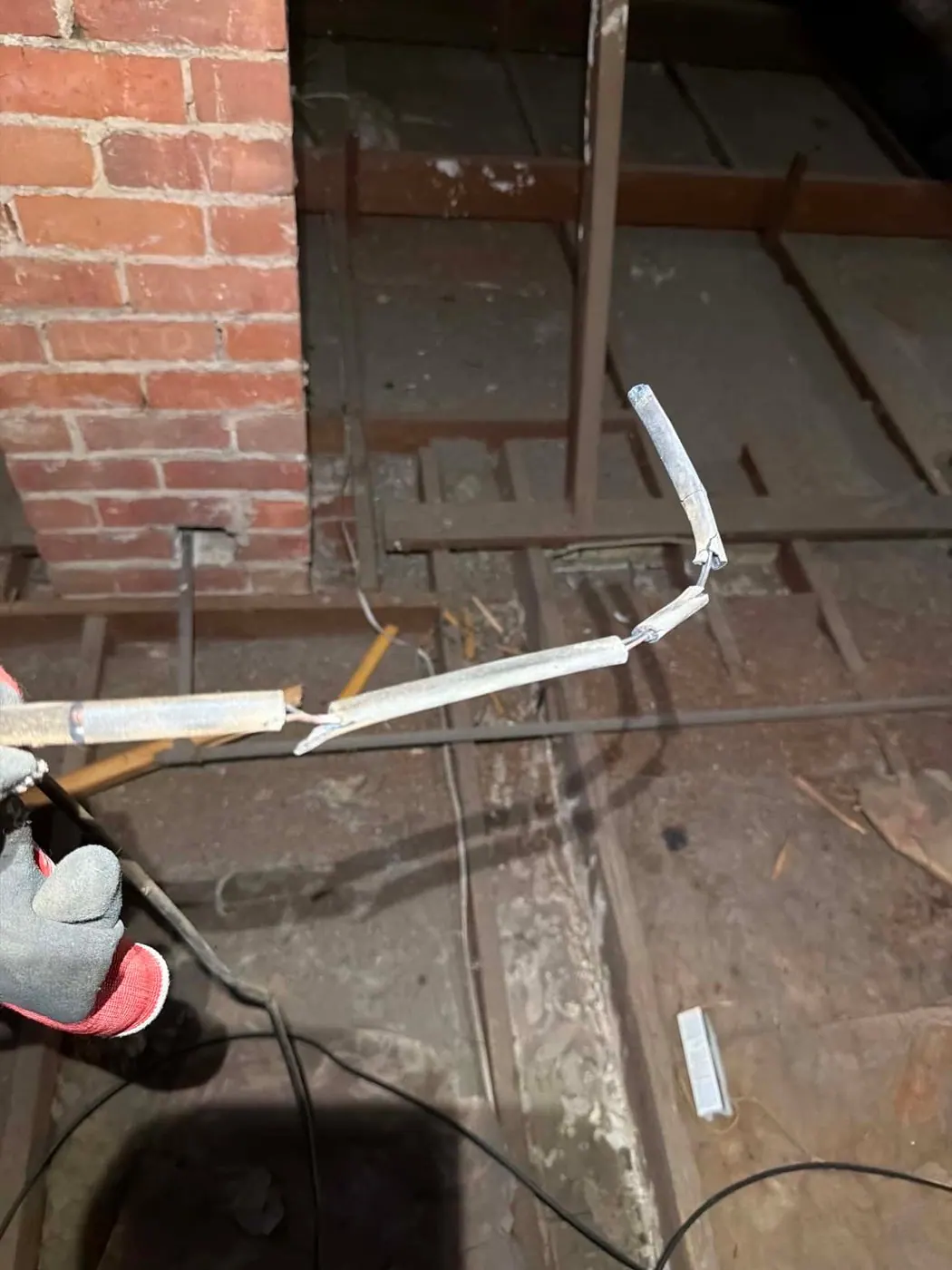
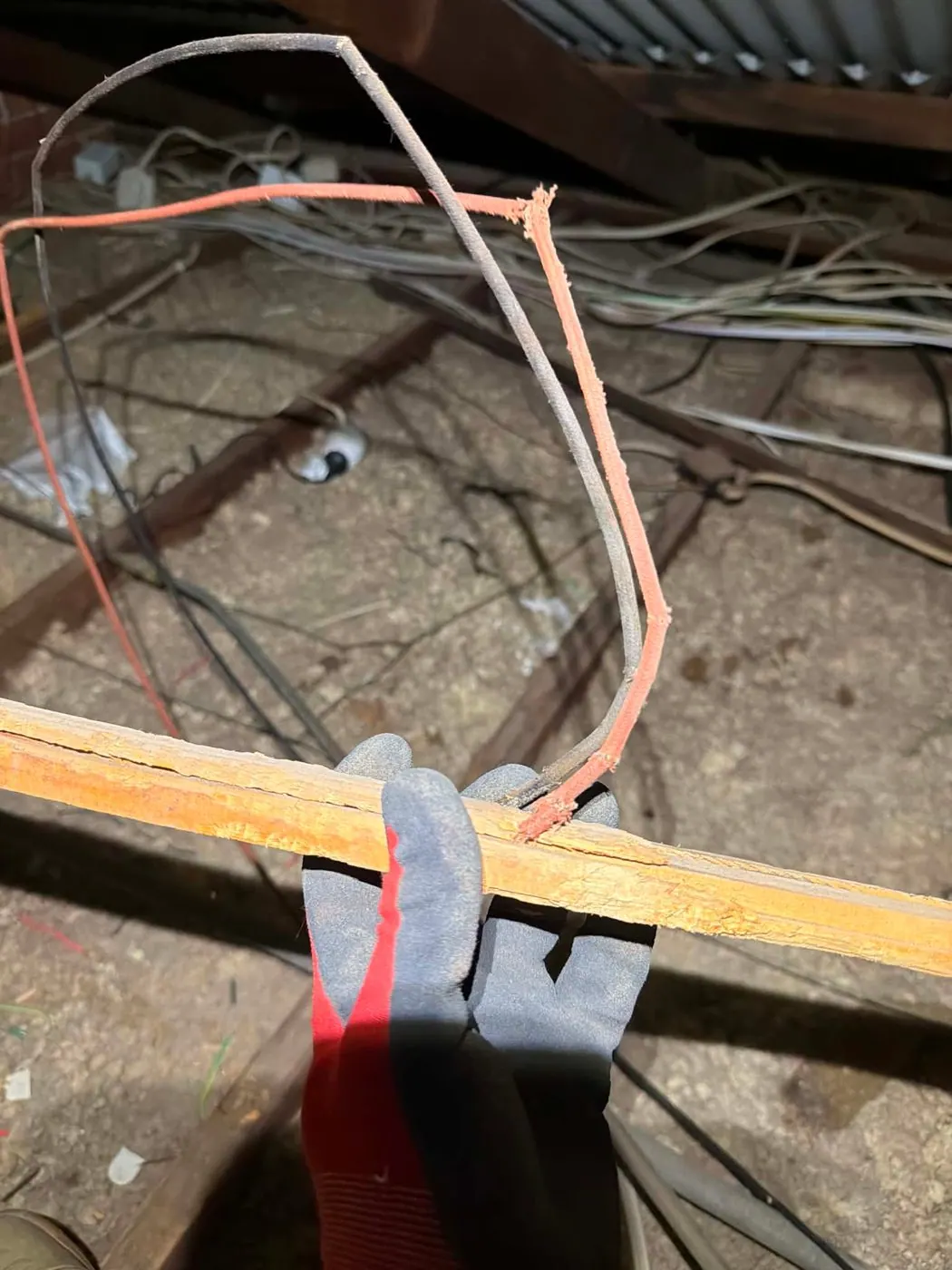
VIR, or vulcanised india rubber. Rubber-insulated conductors, usually with a cotton braid over the top and sometimes a lead sheath. It was excellent cable when it was installed. The problem is that rubber doesn't last. Over fifty or sixty years it oxidises, goes hard and brittle, and then cracks. You can see it in the photo at the top of this page: the sheath has split where the cable has been bent, and the rubber underneath crumbles rather than flexes.
Cotton-braided cable. The braided outer covering frays and opens up, particularly anywhere the cable crosses a batten or a joist and has been rubbing for decades. Once the braid is open, the insulation underneath is exposed to dust, moisture and vermin.
Neither of these is a defect. They're cable doing exactly what cable of that age does. The defect is leaving them in service.
Why Perished Cable Trips Breakers
This is the part that connects the two halves of the story.
Insulation has one job: keep the current inside the conductor. When it perishes, small amounts of current start finding their way out, to earth or between the conductors. Not enough to blow anything up, just enough to be detected.
A safety switch exists specifically to detect current going where it shouldn't, and it doesn't care whether the leak is a person or a sixty-year-old cable. So it trips. Then it holds for a while, then it trips again, usually worse in damp weather because moisture in a roof space makes the leakage worse.
People read that as a faulty safety switch. It's the opposite. The device is doing precisely what it was installed to do, and the answer is to find what it is detecting rather than to keep resetting it. There's more on how these devices are tested on our safety switches and RCD testing page.
Finding It: Insulation Resistance Testing
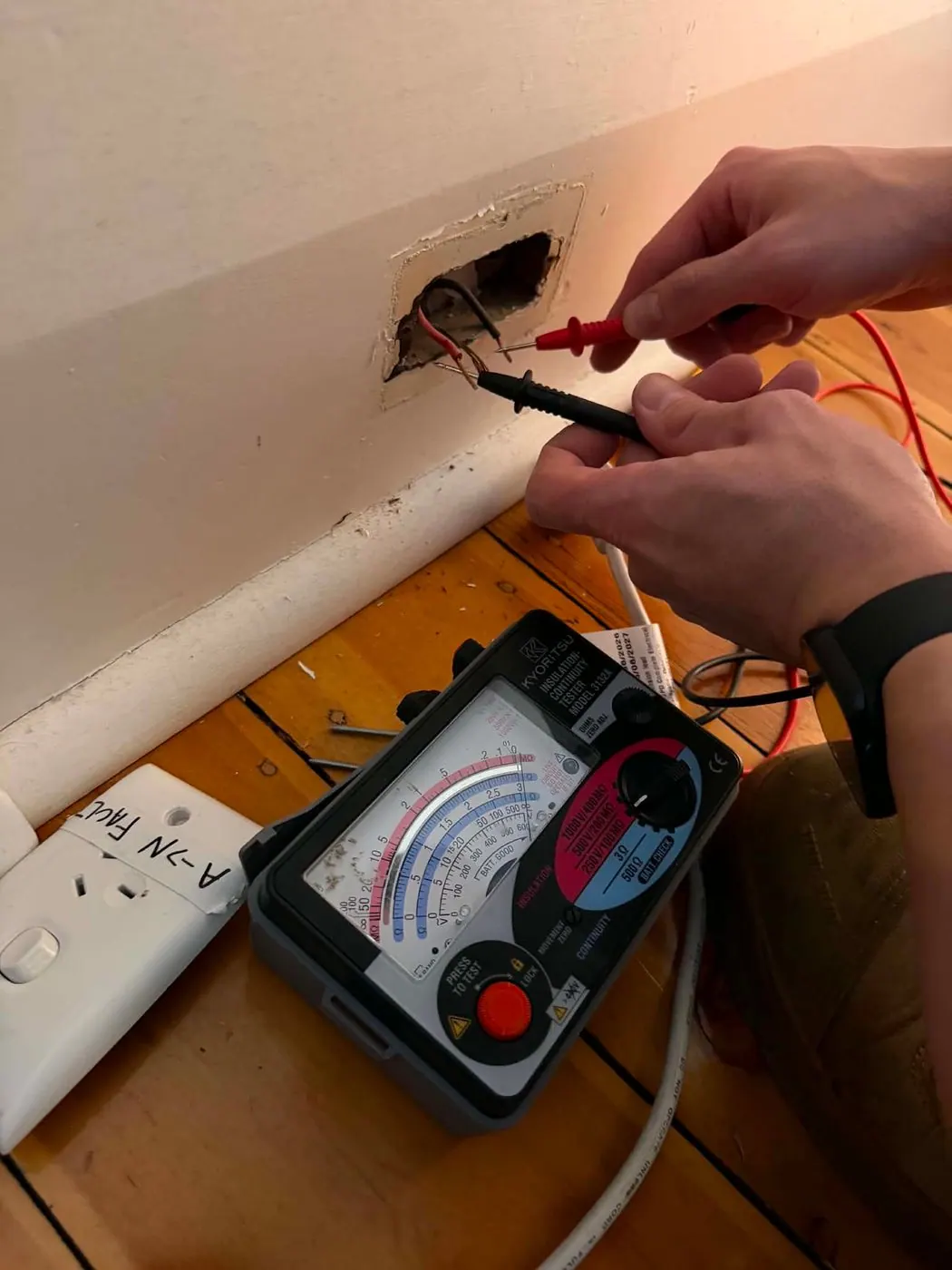
The photo at the top of this page is the actual diagnosis. That's an insulation resistance tester, and the faceplate on the floor is marked in pen with the fault found at that point: active to neutral.
The method is unglamorous and it works. The circuit is isolated, the wiring is divided up point by point, and each section is tested to see whether the insulation is still holding. Sections that pass are ruled out. Sections that fail get labelled, and the pattern of failures shows how far the bad cable extends.
That mapping is what makes a partial rewire possible rather than guesswork. Without it the only honest quote is to do the whole house, because nobody can say which circuits are sound.
The Thing the Previous Electricians Got Wrong
The house had been added to over the years, which is completely normal. What wasn't normal is how.
Newer work had been connected onto sections of the original cable rather than run back to the board. Somebody added a point, found old cable nearby, and joined onto it. Each of those decisions probably looked reasonable at the time and each one was cheaper on the day.
The result is that new cable, new fittings and a new circuit all end up depending on a length of sixty-year-old rubber that nobody looked at. The installation looks modern at the powerpoint and isn't modern behind it. If you have had work done over the years in an older house, this is worth asking about directly: was it run back to the board, or joined onto what was there?
What Got Done
The affected power circuits were rewired. Circuits that tested sound were left, because replacing cable that's doing its job is spending money for nothing.
RCD protection was installed as part of the rectification, which is the other half of the answer. New cable removes the fault that was there. RCD protection covers the faults that turn up later, including on any older cable elsewhere in the house.
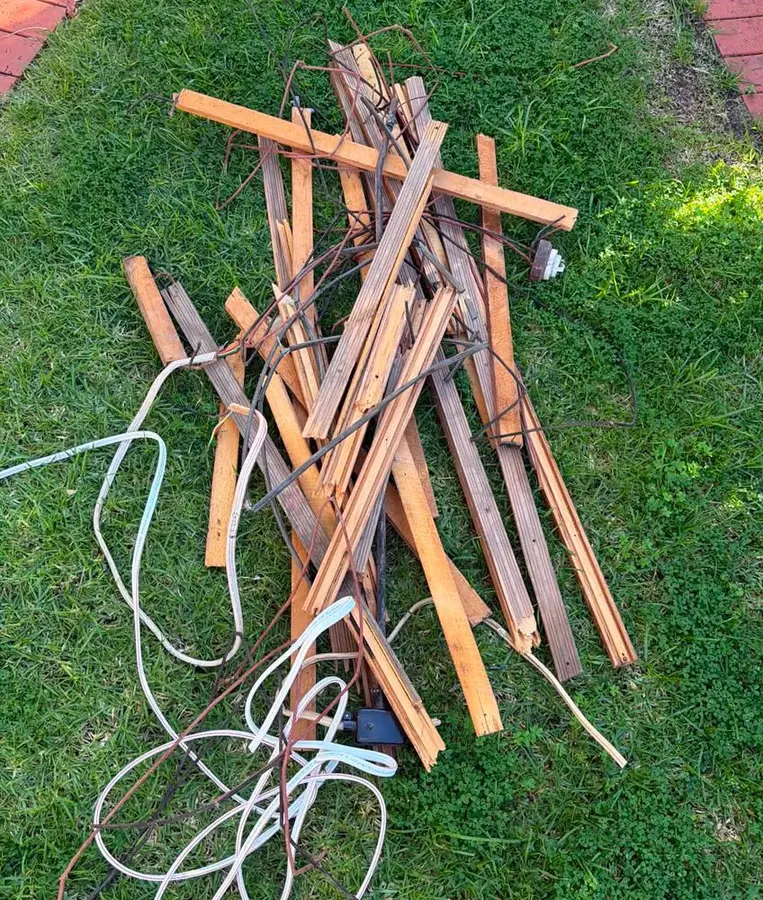
Old cable was pulled out where it could be reached rather than left dead in the walls. It isn't strictly required in every case, but the next person opening that ceiling shouldn't have to work out which of three cables is live.
Partial or Full Rewire?
A full rewire is a serious job. It usually means lifting floors or opening ceilings across the house, and in an occupied home it's disruptive and expensive.
A partial rewire is the right answer when testing shows the deterioration is confined to particular circuits, which is often the case where a house has been extended or partly upgraded already. It's the wrong answer when the failures are spread evenly across everything, because then you're just replacing the worst third and waiting for the next third.
The only way to tell the difference is to test first. Anyone quoting a rewire in an older home without testing is guessing, in one direction or the other.
If Your House Is This Era
Kingswood isn't the only place this cable turns up. The same wiring is common right across Adelaide's older suburbs, including Prospect, Unley, Mitcham, Collinswood and Norwood, and in the older pockets of the north-east.
Worth acting on: repeated tripping with no obvious cause, tripping that gets worse when it rains, a burning or hot-plastic smell, or lights that dim and flicker together. Worth checking without urgency: a house built before the mid-1960s that has never been rewired, particularly if you're about to renovate or you have just bought it.
You don't need to go into the roof to look. A licensed electrician can test the circuits from the board and the points, which is both safer and more informative than seeing one length of cable. If something is already tripping, our fault finding page covers how we go about it.