Why This Matters to You
Mounting a screen on a wall looks like the same job everywhere. In a commercial fitout it isn't, and the differences are all in things nobody photographs: what's behind the plasterboard, where the outlet goes, and who has to be able to reach it in two years.
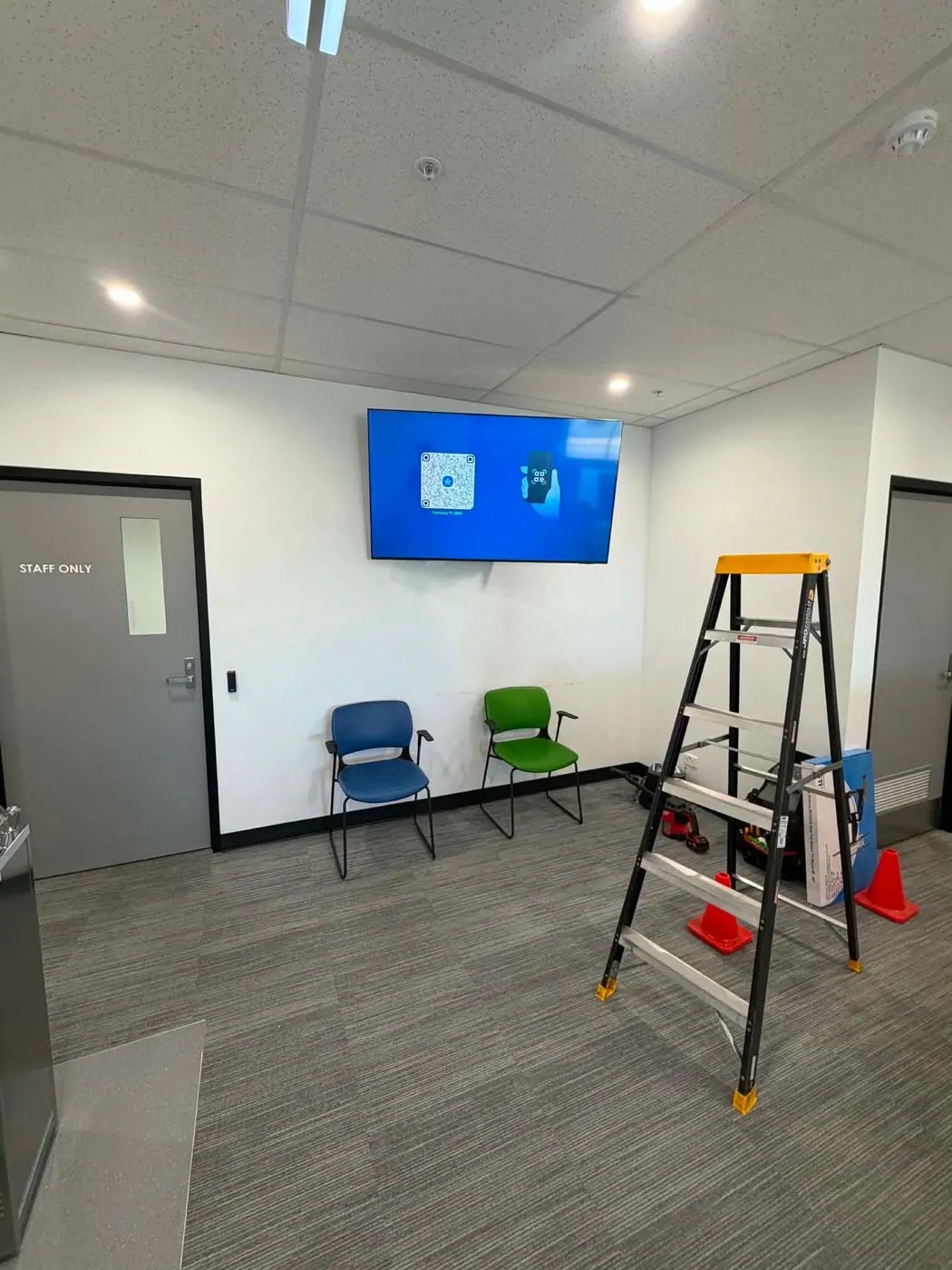
This was a medical premises at Gillman. A screen went into the patient waiting room, on a full-motion bracket, with a new power outlet installed for it.
The Outlet Goes In First
A new power outlet went in specifically for the screen, positioned behind where it would sit.
This is the part people skip and then live with. A screen mounted on a wall with a lead running down to a skirting-level outlet looks unfinished, and in a waiting room it's at eye height for everyone sitting in front of it. Worse, a visible lead is something people pull on and children swing off, and in a medical setting that's a hazard rather than an aesthetic issue.
Putting a dedicated outlet behind the screen means the only thing on the wall is the screen. It has to go in before the bracket, because once the screen is up the wall behind it's gone.
Fixing Into a Commercial Wall
The one genuine technical difference between commercial and domestic screen mounting is what you're fixing to.
In a house the answer is usually timber studs at a known spacing, and you find them and fix to them. Commercial partitioning is often steel stud, sometimes with different sheeting, occasionally with services running through the cavity in places that would surprise you. A full-motion bracket makes that matter more, not less, because of the leverage.
That's the thing to understand about articulating brackets. A screen sitting flat against a wall puts its weight almost straight down. Pull it out on an extended arm and the same screen is now on the end of a lever, and the fixings at the top of the bracket are being pulled directly out of the wall rather than loaded downward. The load on the fixings can be several times higher extended than folded.
So the bracket choice isn't independent of the wall. Deciding on a full-motion mount means the fixing has to suit it, and that's worth establishing before the bracket is bought rather than discovering on the day.
Why Full Motion in a Waiting Room
A waiting room is a genuinely good case for an articulating bracket, which isn't true of most living rooms.
Seating in a waiting area is arranged around the room rather than pointed at the screen, so there's no single viewing position to aim at. A bracket that swivels lets the screen be angled toward wherever the seating actually ends up, and re-angled when the furniture gets rearranged, which in a waiting room it will be.
The other reason is access. Anything behind a screen, the outlet, the bracket bolts, a data point, is unreachable once a fixed mount is up. On a full-motion arm the screen pulls away from the wall and everything behind it's accessible without taking the screen down. In a commercial building that's worth the extra cost on its own, because it means the next person who needs to get in there isn't booking a two-person lift.
Height, and Getting It Wrong
Screens in commercial spaces are almost always mounted too high.
The reason is understandable. Standing in an empty room and holding a screen against the wall, chest height looks low. But the people watching it are seated, often for twenty minutes, and a screen mounted at standing eye level puts them at a permanent upward angle.
The check that works is to sit in the actual chairs before marking the wall. Where the room genuinely needs the screen high, above a counter, or where it has to clear sightlines to a reception desk, that's a real constraint and it's another argument for a bracket that tilts.
If You're Fitting Out a Commercial Space
The screen is the last decision, not the first. What matters is settled before it arrives: where the outlet goes, what the wall is made of, whether the bracket suits both, and whether anything behind the screen will ever need to be reached.
Get those four right and the install is straightforward. Get them wrong and the fix involves patching a wall in a room full of patients.
We do commercial fitout work across metropolitan Adelaide, including Gillman and the Port area. There's more on adding outlets and circuits on our powerpoints and extra circuits page.