Why This Matters to You
A switchboard upgrade is one of the bigger single electrical jobs a house will have done, and from the outside it's hard to see what you paid for. The old box comes off, a new box goes on, the lights work the same as they did before.
So it's worth understanding what actually happens, both so you can plan the day and so you can tell the difference between a proper job and a quick one.
Before the Day
We'll have looked at the existing board and counted circuits, checked the incoming supply and the main earth, and looked at whether the existing enclosure is worth keeping. That count is what drives the price, because every circuit needs its own device and its own termination.
You'll get a time and a rough duration. Most domestic upgrades are a single day. Plan for the power to be off for a good part of it: charge what needs charging, think about the fridge and freezer, and if someone works from home, that day is a problem worth planning around rather than discovering.
The Power Goes Off
We isolate the supply, then the old board comes apart. This is the point where the job either goes to plan or gets interesting, because it's the first time anyone has seen behind the board in decades.
What we're looking at: the condition of the incoming consumer mains, the state of the main earth and whether it's adequate, whether the cables coming into the board are in serviceable condition, and whether anything has been added over the years that shouldn't have been.
On a 1960s or 70s house this is where old rubber-insulated cable sometimes turns up, brittle enough that the insulation breaks away when it moves. If that happens we stop and show you, because wiring a new board onto cable that shouldn't be reused isn't something we'll quietly do.
The New Board Goes In
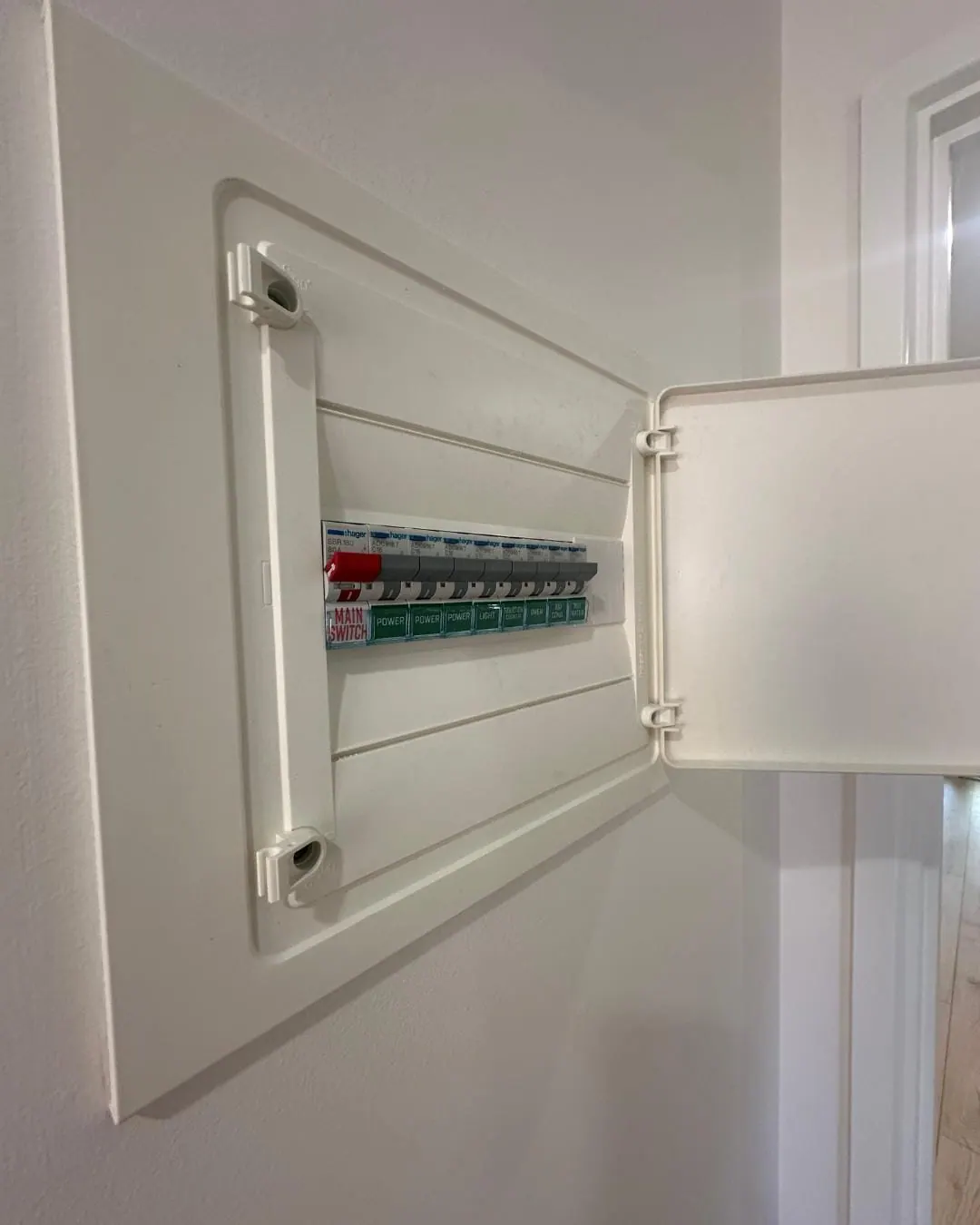
The enclosure gets mounted, then each circuit is brought in, terminated and connected to its own RCBO.
That last part is the actual upgrade. An RCBO combines a circuit breaker and a safety switch in one device, fitted per circuit. It means every circuit in the house gets shock protection, including the lighting circuits that older installations almost never had, and it means a fault takes out one circuit instead of half the house.
The cheaper arrangement is one or two shared RCDs covering groups of circuits. It meets the requirement and it's noticeably worse to live with, because a faulty toaster takes out the fridge, the lights and the alarm at the same time. If you're comparing quotes, this is the difference worth asking about, because it's often why one number is lower.
The main earth usually gets upgraded at the same time. It isn't visible and it isn't optional: it's what makes everything else work as intended.
Then It Gets Tested
This is the part people don't see and it isn't a formality.
- Insulation resistance on each circuit, which is what tells us the cable is sound rather than assumed sound
- Earth continuity, confirming every outlet and fitting is actually connected back to earth
- Polarity, confirming active and neutral are where they should be at every point
- RCD trip time on every device, measured with a calibrated instrument against what the standard requires
That last test is the one that matters most and the one most likely to be skipped. Pressing the test button proves the mechanism moves. Measuring the trip time proves it operates fast enough to protect a person, and that's the entire reason the device is there.
Labelling, Which Sounds Trivial and isn't
Every circuit gets labelled for what it actually controls. Not "Power 1, Power 2, Power 3", but which areas of the house.
This is the difference between standing in the dark working out which breaker to reset, and knowing immediately. It costs us fifteen minutes and it's the thing customers mention most often afterwards.
What You Should Get at the End
- A Certificate of Compliance for Electrical Work
- Your test results
- A labelled board you can understand
- An explanation of anything we found and anything still outstanding
- The site cleaned up, including the old board taken away
Keep the certificate. It's your evidence the work was done by a licensed electrician and verified, and you'll want it when you sell the house or if an insurer ever asks questions after an incident.
What It doesn't Fix
Worth being straight about this. A switchboard upgrade doesn't rewire your house, add powerpoints, or fix a circuit that was undersized to begin with. It replaces the protection and the distribution, not the cabling behind it.
What it does do is give you shock protection on every circuit, capacity to add things later, and a board where a fault is contained and identifiable. On a house that still has ceramic fuses, it's the single highest-value electrical job available.