
RCD Testing & Thermal Imaging: The Maintenance Most Properties Skip

Why This Matters to You
If a connection inside your switchboard is quietly overheating, you won't know about it until it trips, fails, or starts a fire. If one of your safety switches has stopped working properly, you won't find out until someone actually needs it to save them from a shock. Both of these are cheap, fast checks. Neither one shows up on a walk-through, and neither gets fixed by waiting and hoping.
To be direct about it: a switchboard fault left unchecked can start a house fire, and a safety switch that fails to trip when it's actually needed can be the difference between someone getting a shock and someone dying from one. These aren't rare, exaggerated scenarios. They're precisely the outcomes RCD testing and thermal imaging are designed to prevent, and both are entirely avoidable with a routine check.
If you're a landlord, run a medical or disability-care premises, or manage a workplace, there are also compliance obligations tied to this. Skipping it isn't just a safety gap, it can be a legal and insurance problem too.
What RCD Testing Actually Checks
An RCD (safety switch) is designed to cut power within milliseconds if current is leaking somewhere it shouldn't, through a damaged appliance, a nicked cable, or a person. It's the single biggest defence against electric shock in a modern home or workplace. But RCDs are mechanical devices, and like anything mechanical, they can fail to trip when you actually need them to.
Formal RCD testing involves triggering each safety switch with a calibrated test device and confirming it trips within the required time. For homes, this is worth doing every couple of years. For rental properties, medical premises, and workplaces, there are compliance schedules (often annual, sometimes more frequent) tied to insurance and tenancy legislation, and a test report is the only way to prove it's been done.
What Thermal Imaging Catches That RCD Testing Doesn't
RCD testing tells you your shock protection works. It doesn't tell you a connection inside your switchboard has been slowly cooking itself for the last six months. That's where thermal imaging comes in: a scan of your switchboard and circuits with a thermal camera, picking up heat signatures at loose connections, overloaded circuits, and failing components that are completely invisible from the outside.
A connection that's heating up under load is a fire risk that will keep getting worse until it either fails or ignites something. The switchboard looks fine, the lights work, and nothing trips, right up until it doesn't. Thermal imaging is the only practical way to catch this early, and it's done live, with no need to shut anything down.
Who Actually Needs This
Rental properties and medical or disability-care premises usually have compliance obligations that make this a formality rather than a choice. But it's just as relevant for any home or business with an older switchboard, a history of tripped breakers, high-draw appliances (EV chargers, pool pumps, air conditioning), or a switchboard that's never been inspected since the house was built.
How We Run It
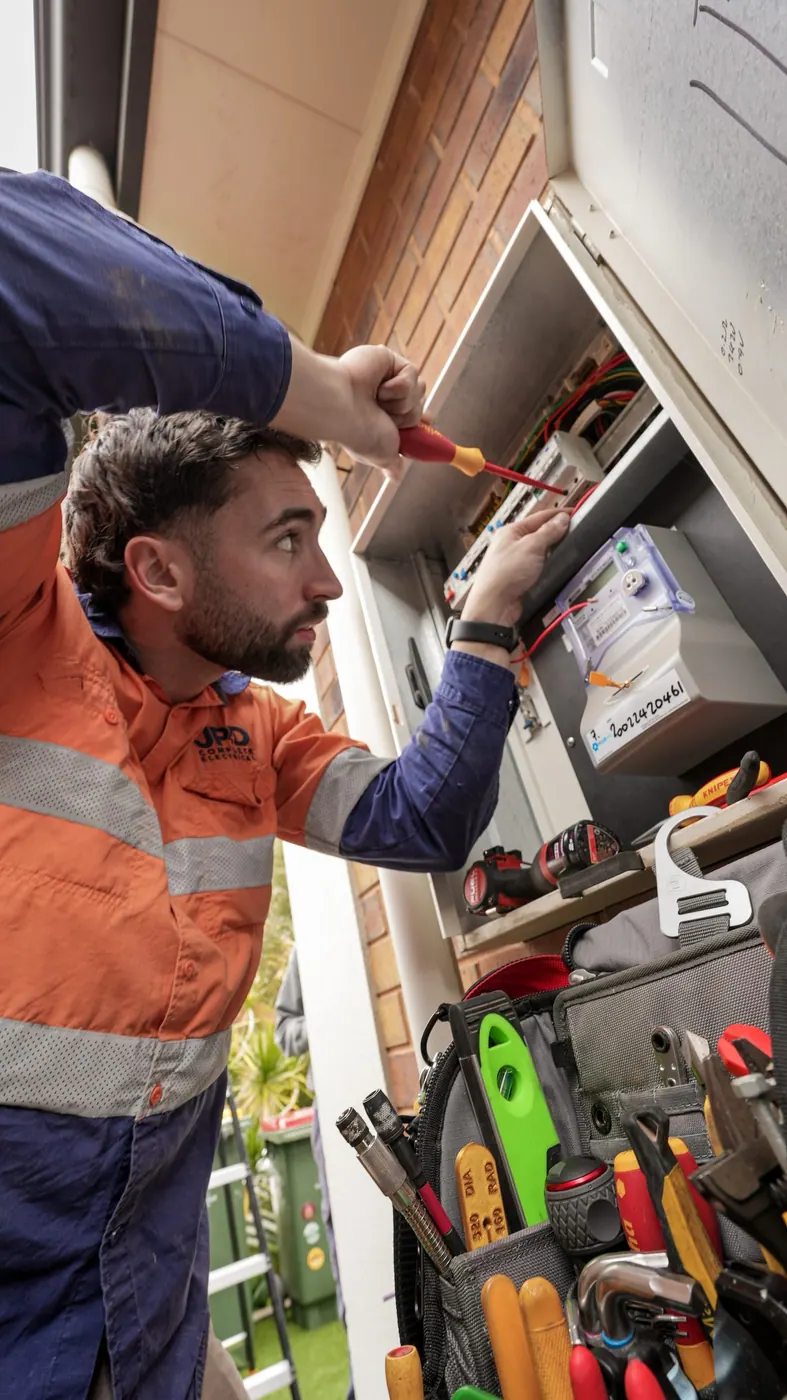
For most properties, RCD testing and a thermal scan are done in the same visit. You get a straightforward pass/fail on your safety switches and a report showing exactly what the thermal camera picked up, with photos. If something's running hot, you'll know precisely which connection or circuit before it becomes an emergency callout.
Related service: Electrical Maintenance & Safety
Book an RCD Test & Thermal Imaging Scan
Protect your property with a combined RCD safety switch test and thermal imaging inspection from JPD Complete Electrical, Adelaide's licensed local electrician.
Book Your RCD Testing & Thermal Imaging ScanOr call 0435 006 420 for a free quote.
