Why This Matters to You
Outdoor heaters are sold as an appliance and installed as an electrical job, and the gap between those two things is where the surprises live.
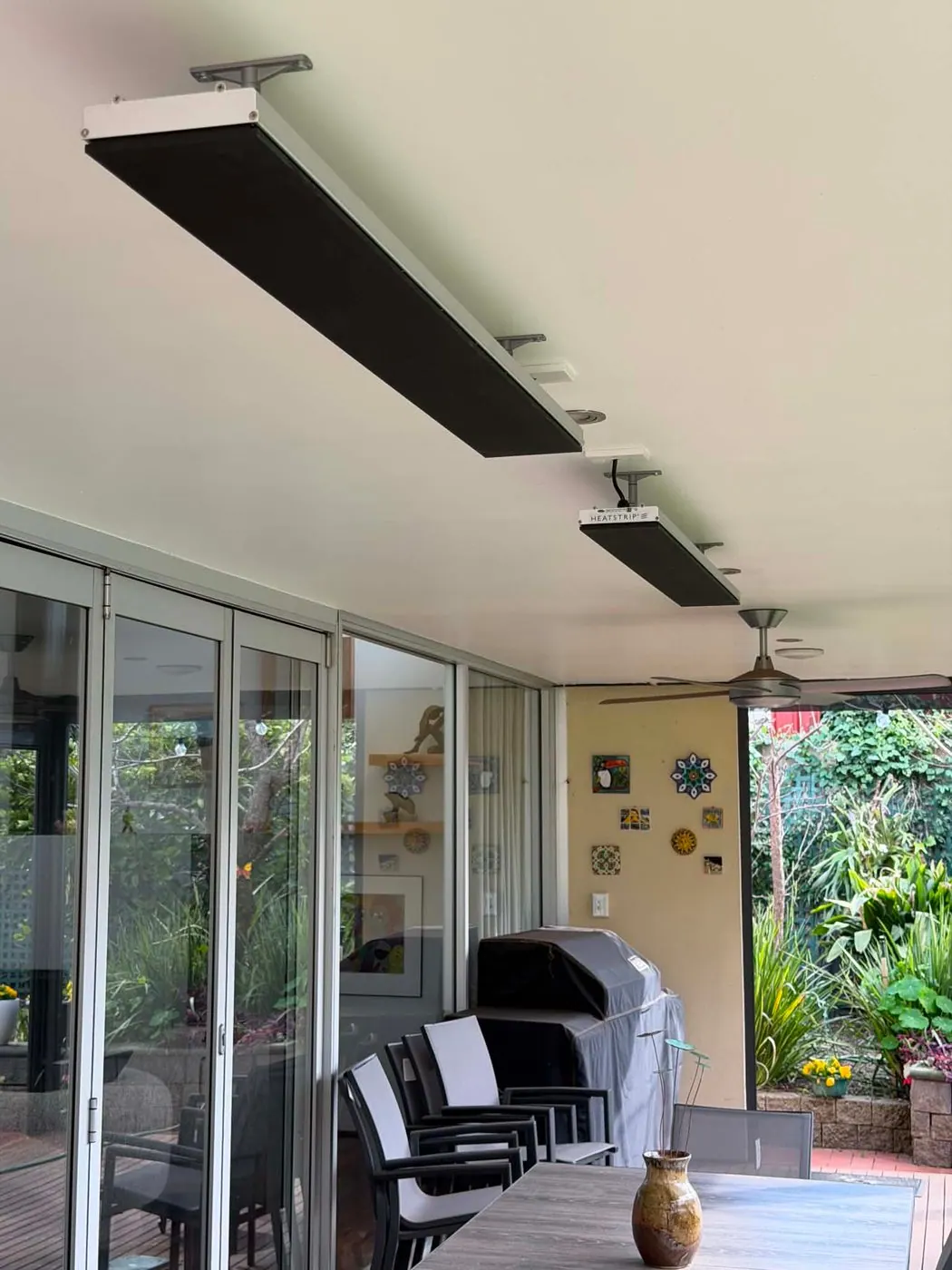
This was an older home in Norwood with a covered alfresco off the back, running out of usable weeks at either end of summer. Two radiant strip heaters went into the ceiling. The heaters themselves took a fraction of the day. Getting the electrical supply out to them took the rest of it.
The Units
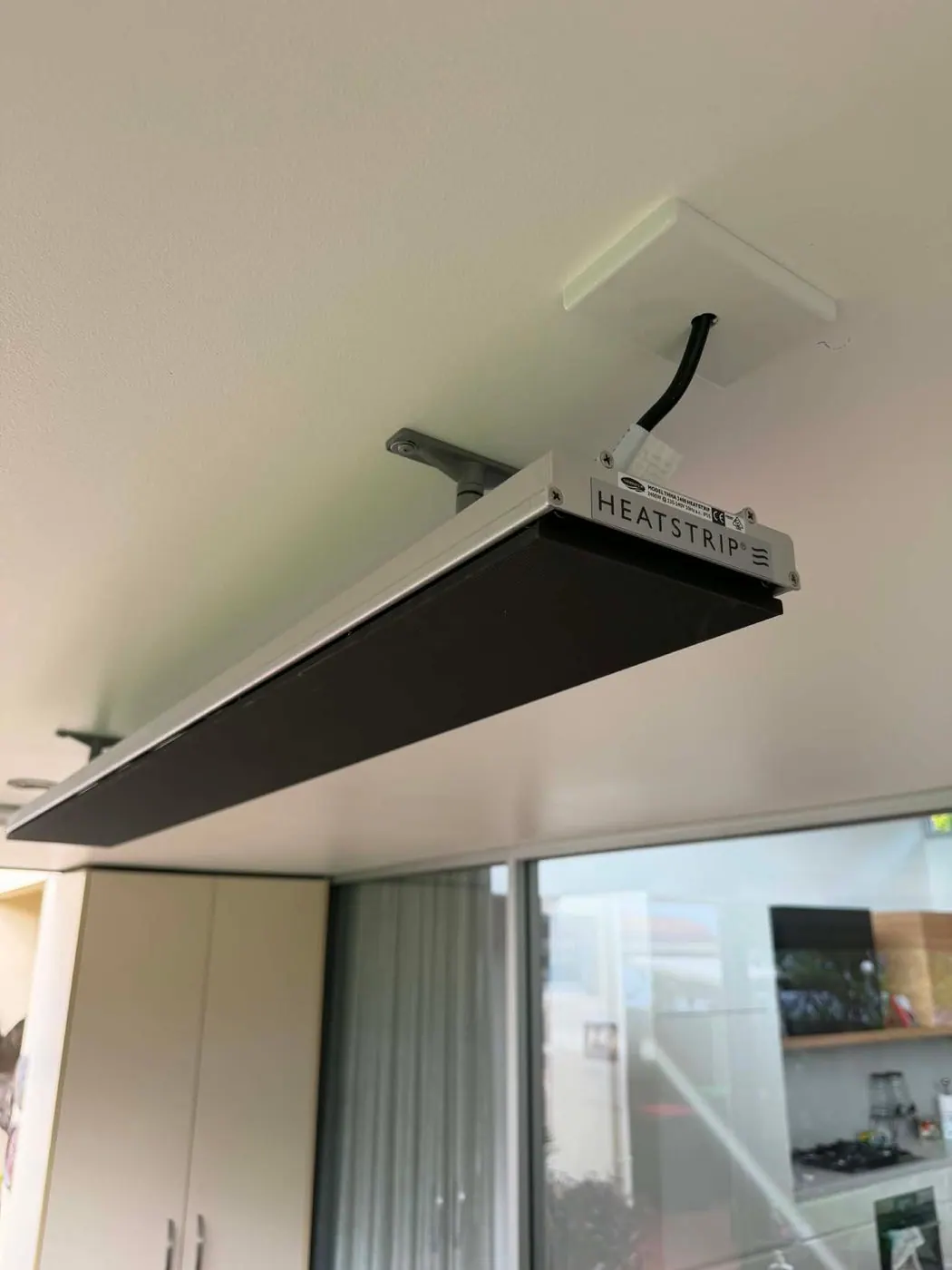
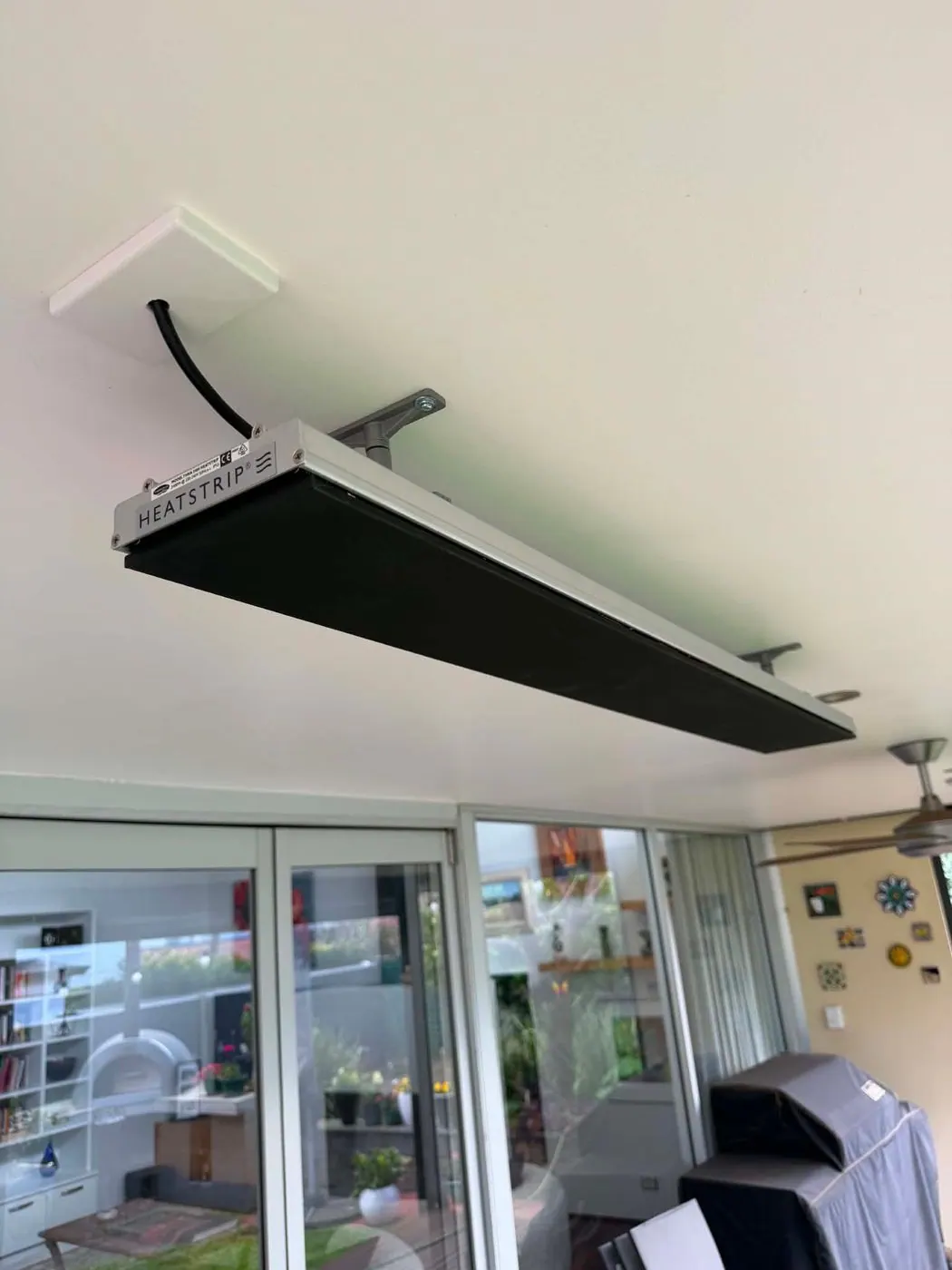
Two Heatstrip units, 2400 watts each, sourced through The Home of Fire on Magill Road at Norwood, so the customer had seen them running in a showroom before committing. That's worth doing with radiant heat, because the specification tells you very little about how it actually feels underneath.
These are radiant heaters, not fan heaters. They warm objects and people directly rather than heating the air, which is the only approach that works outdoors where the air you have just warmed immediately blows away. The practical consequence is that placement matters enormously. A radiant heater warms what it can see. Sit outside its cone and you get very little, which is why the two units here are angled to cover different parts of the seating rather than both pointed at the middle of the table.
They're also ceiling mounted on drop brackets rather than fixed flat. That sets both the height and the angle, and getting it right at install time is the difference between warmth on your shoulders and warmth on the top of your head.
Why Each One Needed Its Own Circuit
This is the part that decides the price, and it's worth understanding before you get quotes.
2400 watts at 240 volts is 10 amps. Continuously, for as long as the heater is on. Two of them is 20 amps.
A general power circuit in a house is typically protected at 16 or 20 amps and already has things on it. Putting two heaters that together draw 20 amps onto an existing circuit means it either trips or sits permanently at its limit, which is worse. A circuit running at its rated current for hours isn't doing anything illegal, it's just running warm indefinitely, and warm is how connections fail.
So each heater got a dedicated circuit run from the switchboard. Not because the rules demand two separate circuits in every case, but because these are large, continuous, predictable loads and separating them is what keeps the alfresco powerpoints usable at the same time.
Two new circuits means two spare ways in the board. That's the check worth doing before you buy anything: if the board is full, the heaters have just become a heater job plus a board job. There's more about that on our switchboard upgrades page.
Where the Six Hours Went
About six hours on site, and most of it was cable.
An alfresco is attached to the house but not inside it. Getting two new supplies from the board out to a covered outdoor ceiling means working out a route through roof space, wall cavity or along the eave, and in an older home the roof space isn't the tidy modern truss space that makes that easy. Then it has to be concealed, supported and terminated to survive being outdoors.
That's why quotes for outdoor heating vary so much for what looks like the same pair of heaters. The heaters are a fixed cost. The route from the board to them is the variable, and it isn't visible from a photo. Anyone quoting outdoor heating over the phone is quoting the easy half.
Wall Switches Versus Remote Control
These are on wall switches, which is the simplest arrangement and the one that fails least.
Other models offer remote or app control, and some have variable output rather than just on and off. They're genuinely nicer to use, particularly if the heaters are high and you're sitting under them. The decision is worth making before installation rather than after, because a controller frequently needs its own supply and a spot to live, and retrofitting that means going back into a finished ceiling.
The one thing worth avoiding is choosing a control method because it saves electrical work. It usually doesn't, and a heater you can't conveniently switch off is a heater that gets left on.
If You're Thinking About It
Check the board for spare ways first. Decide the mounting height and the seating layout before install, because the bracket position isn't something to revise later. Look at the units running somewhere before buying, since radiant output is hard to judge on paper. And get the cable route looked at, because that's what the quote actually turns on.
We did a similar pair of outdoor strip heaters in Golden Grove, which is worth a look if you want to see how the same equipment lands in a different setting. Norwood and Golden Grove are at opposite ends of the metro area but the cold evenings arrive at both of them at the same time, and the job is much the same either way.
We cover Norwood and metropolitan Adelaide generally. There's more on adding new circuits and outlets on our powerpoints and extra circuits page.