Why This Matters to You
You spend money on a house and then for half the hours you own it, nobody can see any of it. Outdoor lighting is the only improvement that shows from the street after dark, and it's the one that turns a paved area you built into somewhere you actually sit.
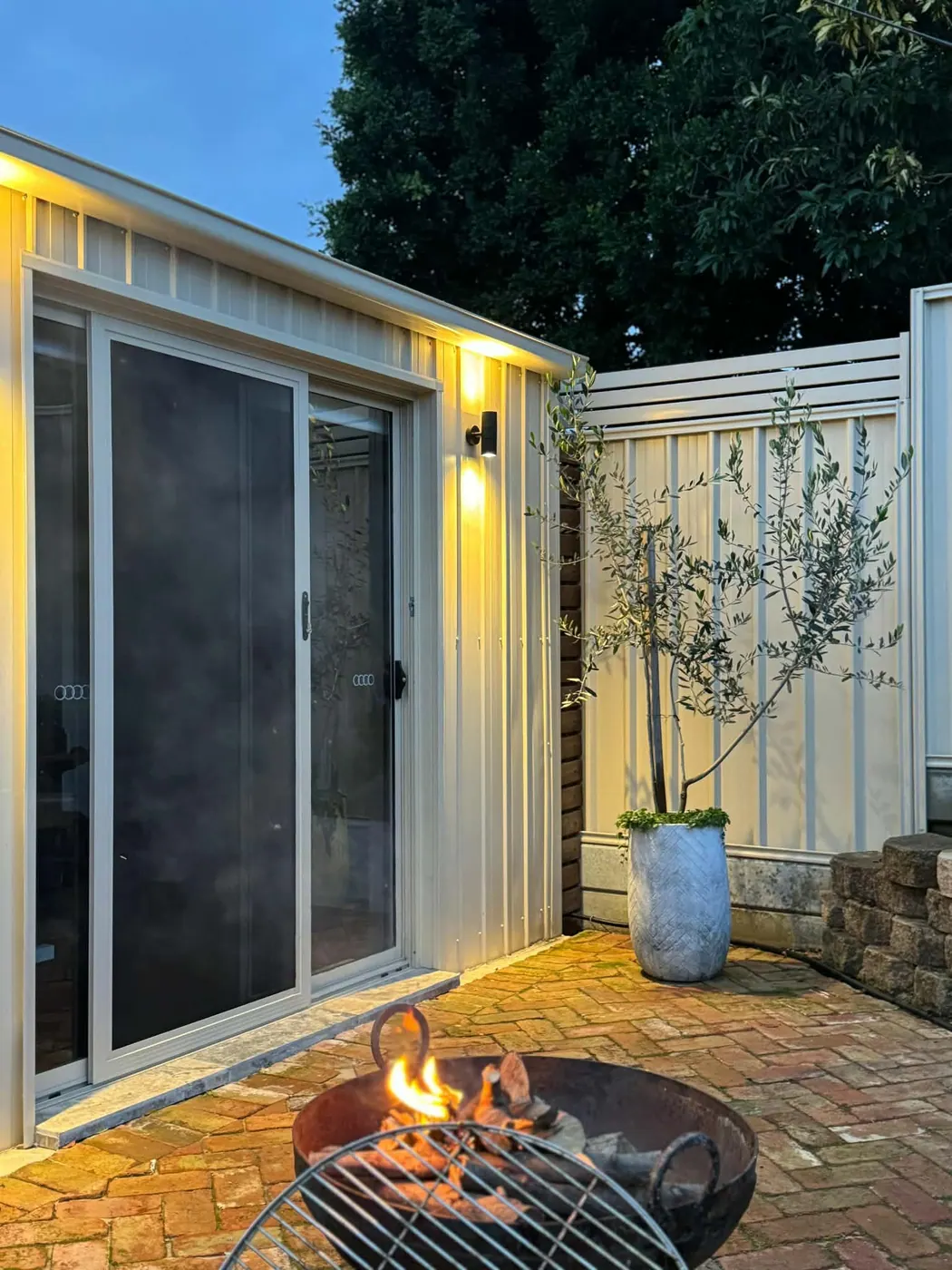
This job in Redwood Park was feature lighting right around the home. Four different types of fitting, including sensor-operated up and down lights on the shed that come on as you walk towards it.
Four Types, Four Different Jobs
The mistake with outdoor lighting is treating it as one thing. It isn't, and using the wrong type in a spot is why some houses end up lit like a car park.
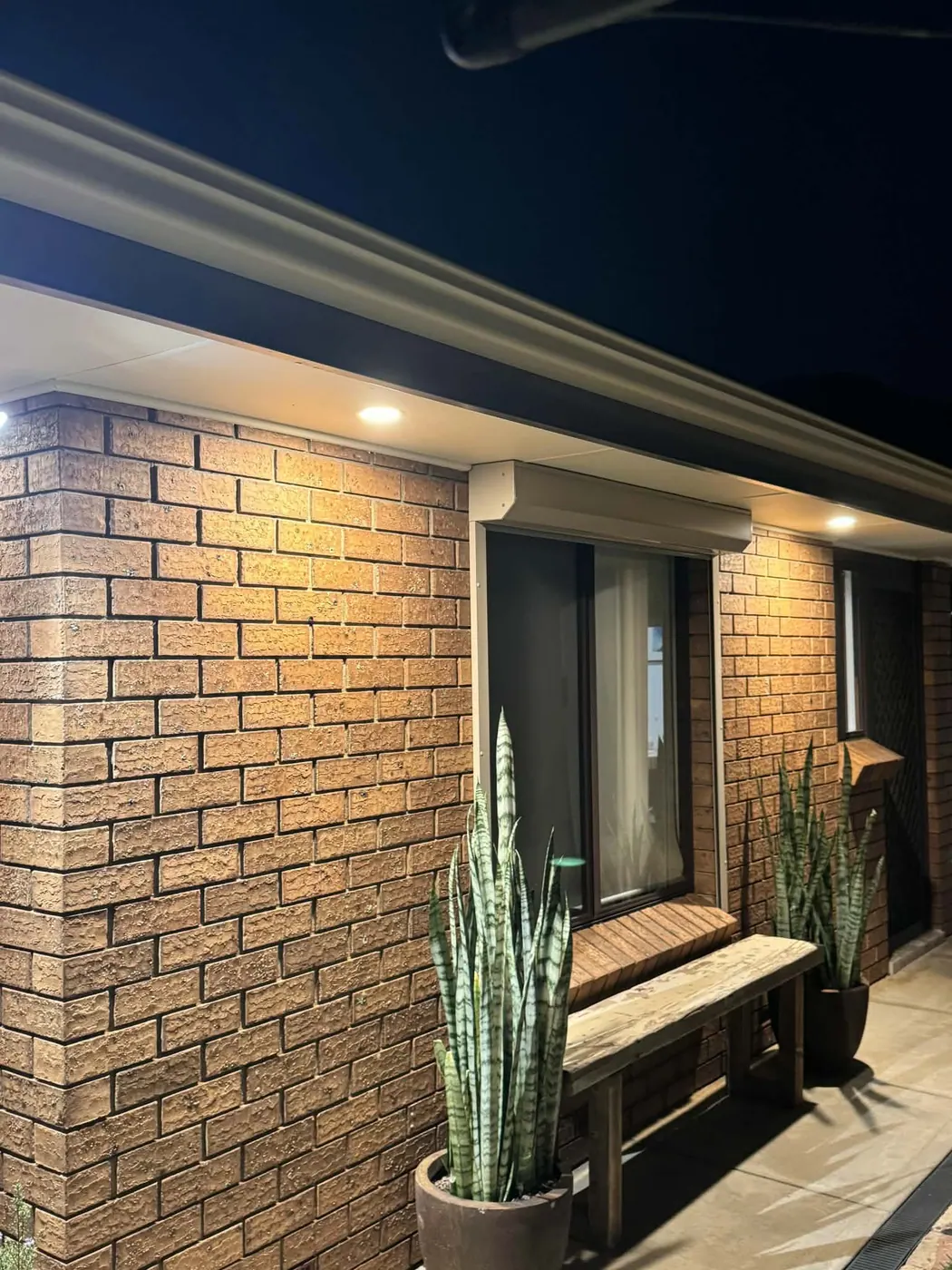
Eave downlights sit in the soffit and wash light down the face of the building. This is the one that makes a house look deliberate at night, because it lights the wall rather than the lawn, and it puts light on the ground close to the house where you actually walk. On brick it picks up the texture, which is why the wall in the photo below reads as a feature rather than a dark mass.
Floodlights cover area. They're the right answer for a driveway, a side path or a yard where you need to see across a space, and the wrong answer anywhere you sit, because they're too much light from one direction.
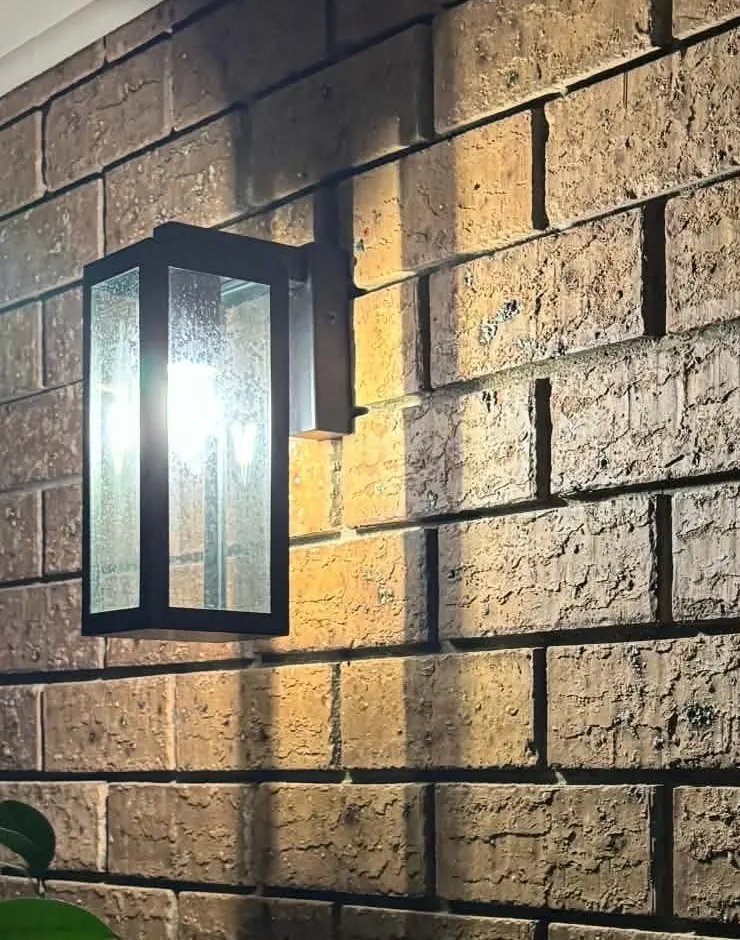
Wall sconces go at entry points. They do a job your eye reads as decorative and a job that's entirely practical, which is putting light on a door and a lock and the step in front of it.
Up and down lights throw a narrow beam in two directions on a wall. They're accent fittings, used to break up a long blank surface, and they work best on a textured wall where the beam has something to catch.
Where Sensors Belong
The shed lights on this job are sensor-operated, so walking towards the shed at night turns them on without anyone finding a switch in the dark.
Sensors suit places you pass through. Approaches, side paths, the walk from the car to the door, anywhere you arrive with your hands full. They don't suit anywhere you sit, because a sensor can't tell the difference between an empty patio and one where four people are sitting still, and a light that switches off while you're having a beer is worse than no light.
Placement is the part that gets botched. A sensor with the road in its field of view will trigger on every car and every dog walker, which is annoying inside the house and useless as a signal that somebody is actually there. It wants to see the approach to your property, not the street beyond it.
Glare, Spill and the Neighbours
The difference between lighting a space and ruining it's aim.
Light should go downward onto surfaces rather than outward into eyes. A fitting aimed even slightly up throws glare straight at anyone walking towards it, which paradoxically makes it harder to see, not easier, because your eyes adjust to the bright source instead of the darker area around it.
The same applies over the fence. A floodlight that covers your yard beautifully may also be pointing into a neighbour's bedroom window, and that's a conversation worth avoiding before it happens rather than after. Aim it, shield it, or move it.
Rated for Outside, and on a Circuit That Can Take It
Everything outside needs to be rated for the location it's in, and there's a real difference between a fitting under a covered eave and one on an exposed wall or in the garden where it gets watered by a sprinkler twice a week.
The other half is the circuit. A full lighting scheme around a house, plus whatever else is out there in the way of powerpoints, fans or heating, is more than a single existing outdoor circuit was built for. Working that out before rather than adding to it until something trips is the difference between a scheme and an accumulation. There's more on our feature lighting page.
If You're Lighting the Outside of Your House
Walk around it after dark first and note what you can't see and what you would like to look at. Those are two different lists and they want different fittings.
Then decide which areas you pass through and which you sit in, because that determines what goes on a sensor and what goes on a switch. Get both right and you end up with a house that looks better at night than it does in the day. There's more on what we do locally on our Redwood Park electrician page.