Why This Matters to You
Home charging is the whole point of owning an electric car. Charging at home overnight is dramatically cheaper than public fast charging, and it means you leave every morning with a full battery instead of planning your week around a charging stop.
But the quotes people get vary enormously for what looks like the same job, and the reason is almost never the charger. It's the switchboard, the distance from the board to the car, and whether the house can carry the load at all. Understanding those three things before you ring anyone will save you a lot of confusion.
The Load Is the Real Story
A typical single-phase home charger draws around 32 amps continuously, for hours. That's a fundamentally different kind of load to anything else in a house. A kettle draws a lot but for two minutes. An EV charger draws a lot all night.
So the first question isn't where the charger goes, it's whether your switchboard and your supply can carry it alongside everything else. We look at the main switch rating, the consumer mains cable, what's already connected, and whether there's physical space in the board for another circuit.
In the newer suburbs like Greenwith and Golden Grove, where a lot of homes already have ducted air conditioning, an induction cooktop and sometimes a pool pump, that check genuinely matters. In the older suburbs like Hope Valley and Holden Hill, the answer is often that the board needs replacing before a charger goes anywhere near it.
Load Management Is Usually Cheaper Than a Supply Upgrade
If the numbers are tight, most people assume the answer is upgrading the supply. Usually it isn't, because that's expensive and slow.
The better answer is normally load management. Most modern chargers can monitor what the rest of the house is drawing and throttle themselves accordingly. In practice that means charging at full speed for most of the night and automatically backing off for the twenty minutes when the oven and the air conditioning are both running.
You barely notice it, because the car is sitting there for ten hours and only needs a few of them. It's a far better use of money than upgrading the incoming supply to handle a peak that happens rarely.
Don't Pay for Three Phase Without Checking the Car
This is the mistake that costs people the most money for nothing.
Most homes in our area are single phase, which caps a wall charger at around 7 kW. That adds roughly 40 kilometres of range per hour. An overnight charge is well over 300 kilometres, which is more than almost anyone drives in a day.
If you already have three-phase supply, a three-phase charger can go to around 22 kW. But here's the part nobody mentions at the dealership: plenty of electric vehicles only accept single-phase AC charging, regardless of what the charger can deliver. On those cars, a 22 kW charger charges at exactly the same speed as a 7 kW one.
Check your vehicle's onboard AC charger rating before spending anything on three phase. And upgrading a single-phase house to three phase purely to charge faster is almost never worth it, because it solves a problem that doesn't exist.
What a Compliant Install Actually Involves
- A dedicated circuit from the switchboard, sized for the charger and for the length of the run
- RCD protection suitable for EV charging, which means a Type B, or a Type A where the charger itself provides 6 mA DC fault detection
- A correctly rated circuit breaker, and board space to fit it
- Notification to SA Power Networks where that's required
- Full testing and a Certificate of Compliance for Electrical Work
That DC fault detection point is worth understanding, because it's a genuine technical requirement rather than an upsell. EV charging can produce smooth DC fault currents that a standard Type AC or Type A RCD won't detect, and which can actually blind that RCD to other faults. Either the RCD handles it or the charger does. Skipping it isn't an option.
Where to Put It
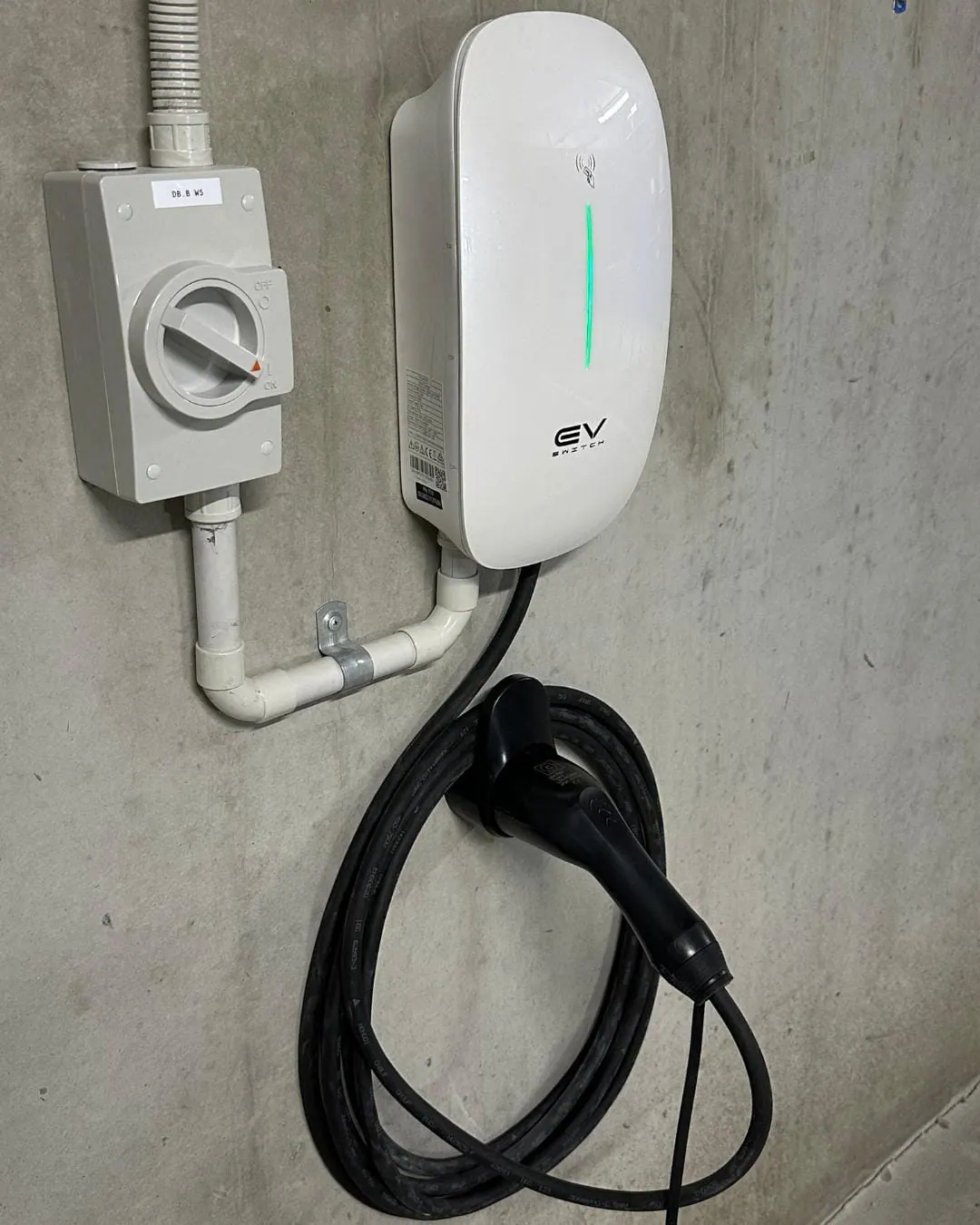
Two things decide this. Where the car actually parks, and where the charge port is on the vehicle. A charger mounted on the wrong side of a double garage means dragging the cable around the car every single night, which gets old inside a week.
The other factor is the distance from the switchboard, and this is the single biggest driver of the install price. A charger on the garage wall directly behind the board is a short run in modest cable. The same charger at a detached garage down a Fairview Park or Vista block is a long run in much heavier cable, and sometimes trenching. The difference between those two jobs is large.
If the charger is going outside, it needs to be rated for outdoor use and ideally positioned so it isn't sitting in the weather more than it has to.
Tethered or Untethered
A tethered charger has the cable permanently attached. Untethered has a socket, and you use your own cable.
Tethered is more convenient day to day, because you pull the plug off the wall and go. Untethered is tidier when not in use, works with different connector types, and means a damaged cable is a cheap replacement rather than a service call. For a single-car household that keeps the same car for years, tethered usually wins on convenience. For anything else, untethered is the more flexible choice.
What to Have Ready Before You Call
- The make and model of the car, so we can check its onboard AC charging rate
- The charger model, if you have already chosen one
- A photo of your switchboard with the cover open
- A rough idea of the distance from the board to where the car parks
- Whether the parking spot is in a garage, carport or open driveway
With those five things we can tell you most of what you need to know before anyone drives anywhere.