Why This Matters to You
An Adelaide summer evening outdoors is pleasant right up until the air stops moving. Then the space you built to sit in becomes the space you look at from inside where the air conditioning is.
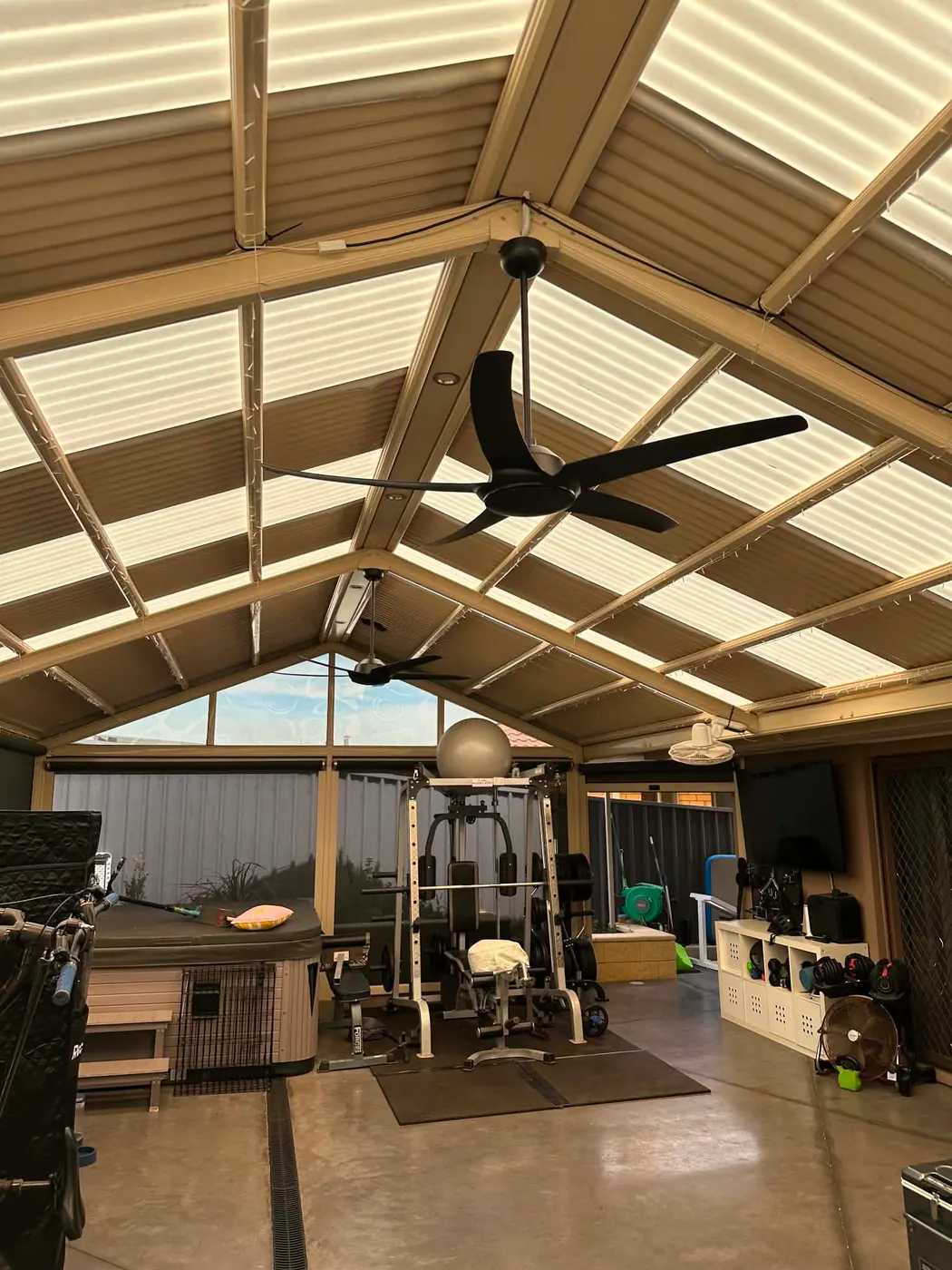
This job in Ridgehaven was two large ceiling fans, supplied by Beacon Lighting, installed under a pergola over an outdoor area that also holds a gym setup and a spa. The point was simply to get enough air moving that the space is usable on a still night.
An Indoor Fan won't Do
The first thing that matters is that a fan under a pergola is an outdoor fan, even though it's under a roof and never gets rained on directly.
Outdoor air carries moisture, and in an open structure it moves through constantly. An indoor fan put in that position corrodes at the motor housing and fixings, and timber or MDF-cored blades absorb moisture and start to droop unevenly. A drooping blade puts the fan out of balance, an out-of-balance fan wobbles, and a wobbling fan works its own fixings loose. It's a slow failure that starts as an annoyance and ends as something hanging off a rafter.
Fans rated for outdoor or damp locations have sealed motors and blades that don't take up water. It's the single most important choice in the job and it's made at the shop, not on site.
Fixing Into a Pergola isn't Fixing Into a Ceiling
Inside, a fan goes to a ceiling joist through plasterboard, and the fixing is hidden. A pergola has exposed rafters and beams and a raked or gabled roof, as this one does, so the fixing is both visible and structural.
A ceiling fan isn't a static weight. It's a rotating mass applying a continuous side-to-side load for years, and the fixing has to be into structural timber that can take that rather than into a batten or a lining board. The mount also has to sit square to level, because a fan hung off a sloped rafter without correcting for the angle will spin out of plane and wobble no matter how well it's balanced.
On a raked roof, the downrod length becomes a real decision too. It sets how far the blades sit below the roof line, which affects both how well the fan moves air and whether anyone on the gym equipment underneath is going to reach it.
Why Two Rather Than One
A ceiling fan only really moves air in the column beneath itself. A single fan in the middle of a long outdoor room leaves both ends still, which people usually read as the fan being underpowered when the problem is coverage.
Two large fans spaced along the space is a different result entirely. Blade span does more for air movement than motor speed does, which is why a big fan turning slowly is both more effective and much quieter than a small one working hard. In an outdoor area you sit and talk in, quiet is worth paying attention to.
If You're Adding Fans Outside
Work out the fan and the fixing points before you buy, particularly under a raked or gabled roof, because the downrod and the mount depend on the structure and the ceiling height. Check the fan is rated for outdoor use even if it will be under cover.
Then think about the circuit and the switching. An outdoor entertaining area that gains fans usually also wants lighting, weatherproof powerpoints and sometimes heating, and those together are more than an existing outdoor light circuit was built for. It's much cheaper to allow for that in one visit than to add each piece separately. More on our ceiling fan installation page, and on what we do locally on our Ridgehaven electrician page.