Why This Matters to You
Most people assume a building inspection covers the electrical. It generally doesn't, or not in any depth. A building inspector is looking at structure, moisture and pests. They will note an obviously ancient switchboard, but they aren't testing circuits, measuring insulation resistance or opening the board.
That matters in Adelaide's north-east, because a huge share of the housing across Hope Valley, Modbury, Holden Hill, St Agnes and Banksia Park went up between the 1960s and the 1980s. A lot of it's still on the original board and the original wiring.
None of that means don't buy the house. It means know what you're buying, because the difference between a board upgrade and a rewire is thousands of dollars and it's worth knowing which one you're inheriting before you bid.
What You Can Check Yourself at an Open Inspection
You don't need tools and you aren't doing anything unsafe. You're just looking.
- Open the switchboard door. Ceramic fuses with fuse wire mean the board is original and pre-dates safety switches entirely. Rows of modern breakers with "Test" buttons mean someone has upgraded it.
- Count the safety switches. Look for devices with a small test button. None at all is the most common finding in an untouched house of this era, and it means no shock protection anywhere.
- Look for spare space. A board with no empty ways can't take a new circuit, so any future air conditioning, EV charger or renovated kitchen means replacing it.
- Look for heat. Brown or black discolouration around terminals, melted plastic, or a faint burning smell are all reasons to get it looked at before settlement.
- Count the powerpoints per room. Two per bedroom is normal for a 1970s build. If you work from home, that's a cost you'll incur.
- Check the light fittings. Halogen downlights everywhere means a replacement job and likely insulation cut away around each one in the ceiling.
- Look for extension leads doing permanent work. A lead running to a fridge or under a rug tells you the circuit layout doesn't match how the house is used.
- Look at the meter box outside. Rust, a door that won't close, or an obviously ancient main supply is worth noting.
What You can't See, and Why It Matters
The wiring itself is the part that decides whether you have a small job or a big one, and you can't assess it by looking at a switchboard.
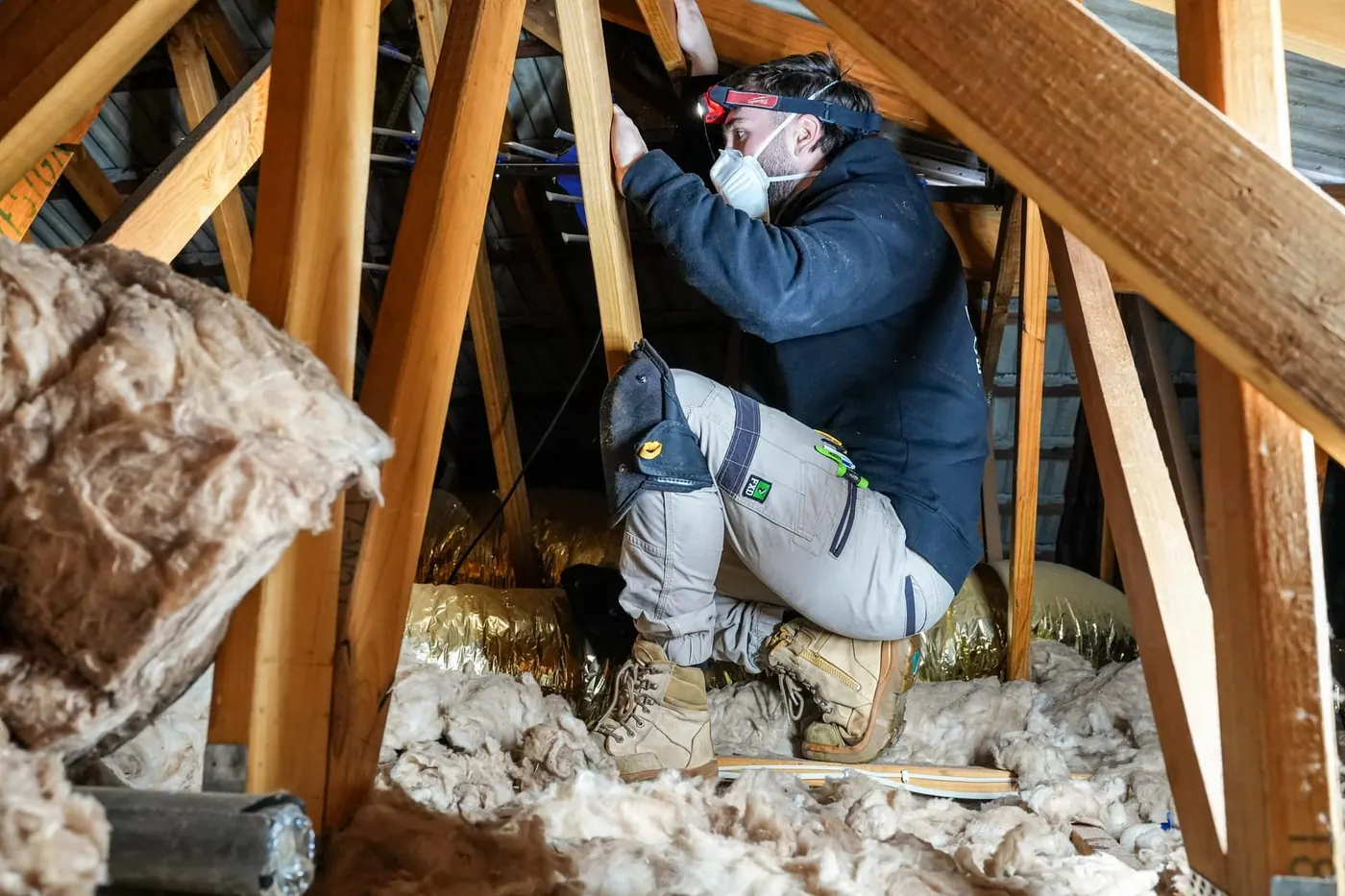
Houses wired before roughly the 1960s often used rubber-insulated cable. Rubber goes brittle with age and the insulation can crumble away when disturbed, which is exactly what happens when someone works in the roof space. Cotton-braided and early PVC cable from the 1950s and 60s has similar issues.
From the 1970s onward, standard PVC cable is generally in serviceable condition and can stay. So the age of the house is a genuine predictor here, and it's why a 1955 cottage and a 1978 brick veneer are completely different propositions even if both boards look equally old.
The only way to know is testing: insulation resistance, earth continuity and polarity on each circuit. That's a pre-purchase electrical inspection, and on an older property it's one of the better few hundred dollars you can spend before committing several hundred thousand.
Cheap Findings Versus Expensive Findings
Usually manageable: no safety switches, a full board, not enough powerpoints, halogen downlights, an old exhaust fan, a shed on an undersized submain. These are all normal upgrades on a house of this age and they're planned work, not emergencies.
Worth pricing before you commit: deteriorated rubber or cotton-braided cable, an unearthed lighting circuit, aluminium wiring, a switchboard with an asbestos-backed panel, or evidence of unlicensed DIY work. Any of those changes the number materially.
The one that catches people out is the asbestos-backed panel, common in boards from roughly the 1960s and 70s. It doesn't make the house dangerous to live in, but it does change how the board has to be removed and that's reflected in the price.
Evidence of DIY Is the Real Red Flag
Of everything on this list, unlicensed work worries us most, because it tells you nothing about how much of it there is.
Signs include: outlets or switches that don't match the others, junction boxes in odd places, cable stapled along a skirting board or run on the surface of a wall, a light switch that controls something illogical, or wiring in a shed or pergola that looks like it was done by someone with a drill and enthusiasm.
Ask the agent whether there are Certificates of Compliance for any electrical work. In South Australia licensed electrical work should have one. No paperwork for obviously recent work is worth asking about.
What to Do With What You Find
Get it priced before you settle rather than after. A quote for the electrical work is a negotiating position if you're still in the process, and a budget if you have already committed. Either is better than a surprise in month two.
And prioritise honestly. If the board has no safety switches, that's the first job regardless of anything else on the list, because it's the only thing there that's about somebody getting hurt rather than about convenience.