Why This Matters to You
Almost everything written about switchboard problems is about old boards. Ceramic fuses, no safety switches, asbestos backing. That's fair enough, because old boards are the bigger problem overall.
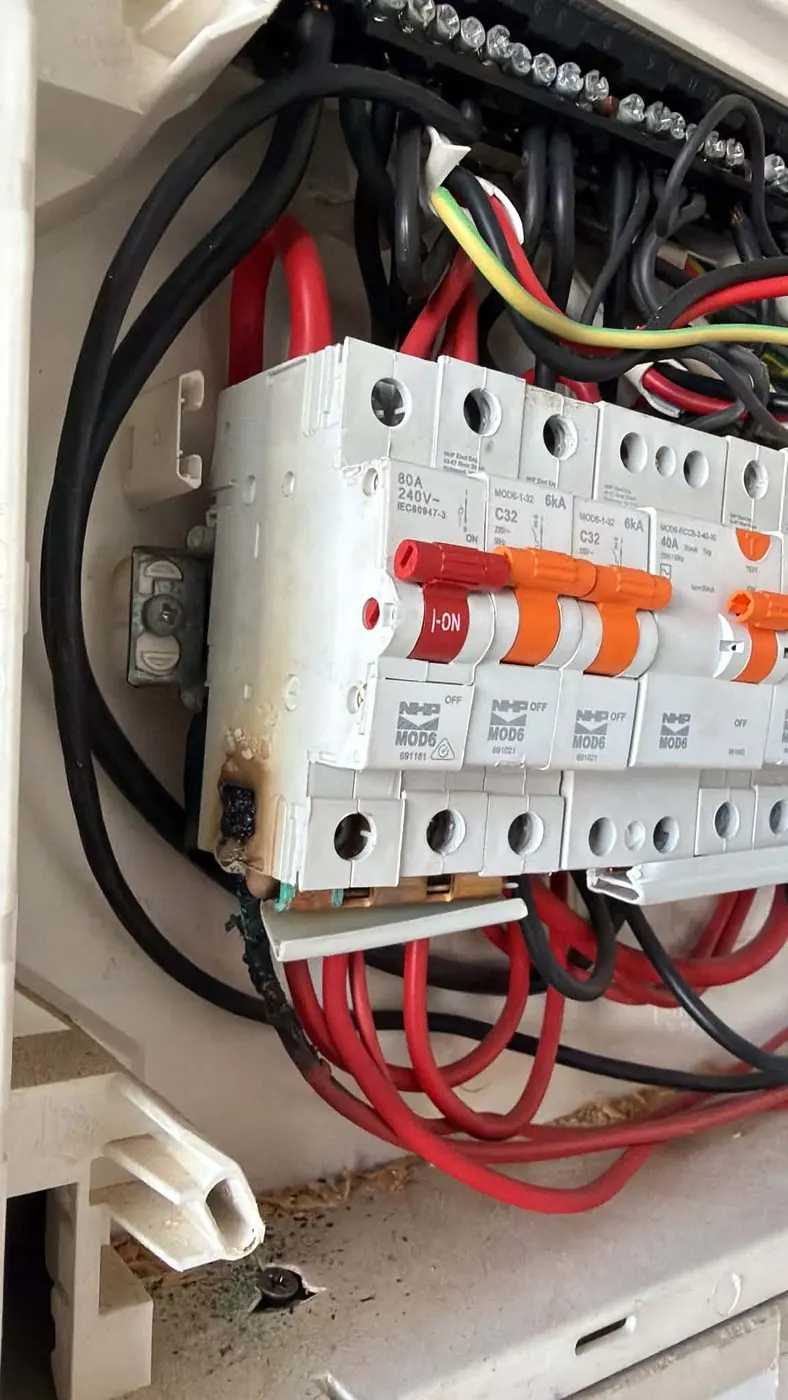
This one wasn't old. The property was relatively modern, the board was a tidy row of modern breakers with a proper RCD, and from the front there was nothing to see. Behind the cover, the main switch was burnt.
What Was Found
The photo on this page is the board with the cover off. The main switch is an 80 amp device at the left of the row, and the bottom corner of its casing is charred black, with the damage running down onto the cable tail below it.
Nothing had tripped. Nothing had stopped working. A breaker protects the circuit downstream of it against overload and short circuit, and a safety switch protects against current leaking to earth. A connection generating heat inside a terminal is neither of those things. It can run for months without a single protective device having any reason to operate.
What it does produce is a smell, and that's usually the only warning anyone gets.
The Cause: A Loose Connection From Earlier Solar Work
The damage traced back to a loose connection associated with a previous solar installation.
The mechanism is simple and it's worth understanding, because it explains why this isn't a rare fault. Electricity passing through a joint meets some resistance. A properly torqued terminal has almost none, so almost no heat. A terminal that's slightly loose has more resistance, so it warms up. Warming makes the metal expand and contract with every load cycle, which works the connection looser still, which makes more heat.
It's a feedback loop with no natural stopping point short of the plastic around it charring, and it accelerates. That's why a connection can sit there for two years doing nothing much and then damage a switch in a fortnight.
Solar work is a common trigger simply because it means somebody has been inside the board making connections at the main switch and the meter. Any work in a board is, for the same reason. It isn't an argument against solar and it isn't evidence that the installer was careless. It's an argument for the board being looked at properly afterwards rather than just closed up.
What This Means If You Smell Something
A burning, hot-plastic or fishy smell around a switchboard is the one symptom on the list that isn't a plan-for-it item.
Everything else about an ageing board, no spare ways, hand-written labels, an old safety switch, is worth sorting out when you're doing something else anyway. Heat is different, because heat is already damaging something and the damage compounds.
Don't take the cover off. The parts that get hot are the incoming connections, and those are live regardless of the position of your main switch. Turning everything off at the board doesn't make the terminals inside it safe.
Don't try to tighten anything. This is the specific thing that turns an expensive repair into a serious injury.
Switch off at the main switch if you can smell it strongly and nobody can attend immediately. That removes the load through the board, which removes most of the heating.
Then get someone out. Our emergency electrician page covers what happens when you call.
Age isn't the Warning Sign People Think It Is
The useful thing about this job is that it breaks the rule of thumb everyone carries around.
A board full of modern devices with printed labels reads as fine, and mostly it is. But connection failures aren't a function of the age of the devices. They're a function of whether every terminal in the board was properly tightened, and whether anything has been done to the board since.
The practical version: if your board has had work done to it, solar, an EV charger, air conditioning, a new circuit for a shed, it's worth having the connections checked at some point afterwards. Not urgently, and not as a separate call-out, but the next time an electrician is there for something else. It takes minutes with the cover off, and this is the fault it finds.
A thermal camera finds these before they become visible, because a hot joint shows up on a scan long before it chars anything. That's what our thermal imaging inspections are for, and it's why the commercial version of this check is done that way as routine.
What Was Done
A burnt main switch isn't repairable. The device is replaced, the cable tail is cut back past the damage and re-terminated, and everything else in the board is checked at the same time, because a loose connection is rarely the only one.
Whether that turns into a full switchboard upgrade depends on what the rest of the board looks like. On a modern board it's usually a repair. On an older one, replacing a burnt main switch on a board that's already at the end of its life is money spent twice.
We cover Tea Tree Gully and the surrounding north-eastern suburbs, and there's more about what we do locally on our Tea Tree Gully electrician page.